
Timeline
Actions That Fire on the First Click, and Connector Errors That Explain Themselves
Table and toolbar actions fire on the first click, hover-only actions stay visible when you reach them with the keyboard, and a connector that refuses a request now says what actually went wrong.
One click, and the keyboard too
Reset, Recompute and Skip act on click: The table cell actions run when you click them instead of needing a second go.
Toolbar commands act on click: Rich text and slide text toolbar commands activate on click.
Hover-only actions survive the keyboard: An action that only appears on hover stays visible when it takes keyboard focus, so it can be reached without a mouse.
Tab leaves the table: Tab moves out of the project table rather than cycling inside it, and a focused cell is scrolled into view rather than left off screen.
Connectors that explain themselves
A refusal reads as a refusal: A 403 from a connection that is already authenticated is reported as what it is, so the problem reads as a permission rather than a broken connector.
No phantom administrator: The misleading notice telling you an administrator has to enable something is gone from OAuth connectors that need no such thing.
Switch client from the connection widget: The in-chat connection widget can move a connector onto the V7 template client, so the switch no longer means leaving the conversation for the settings page.
Reporting exports
A line per API key: The Users CSV writes one line per API key rather than folding them into a single row, so machine traffic can be read key by key in a spreadsheet.
One canonical email column: The Users and Chats CSVs both name the email column user_email, so two exports can be joined without renaming a column first.
Slides
Image crops survive the export: A cropped image renders in the unit PowerPoint expects, so a deck looks the way it did in V7 Go.
Fonts load: Google Fonts load reliably in slides rather than falling back part of the time.
Chat
What it says to you stays readable: Text meant for you stays prominent while work is running underneath, instead of being buried in the activity around it.
Steering continues cleanly: A conversation redirected mid-run picks up from the steer rather than stumbling over it.
Underneath
Archived runs stay archived: A calculation cannot start on an archived run, so an archive stays a record rather than becoming live work again.
Fewer wasted cache reads: A cache miss fills a placeholder instead of reading twice.

Read more
Actions That Fire on the First Click, and Connector Errors That Explain Themselves
Table and toolbar actions fire on the first click, hover-only actions stay visible when you reach them with the keyboard, and a connector that refuses a request now says what actually went wrong.
One click, and the keyboard too
Reset, Recompute and Skip act on click: The table cell actions run when you click them instead of needing a second go.
Toolbar commands act on click: Rich text and slide text toolbar commands activate on click.
Hover-only actions survive the keyboard: An action that only appears on hover stays visible when it takes keyboard focus, so it can be reached without a mouse.
Tab leaves the table: Tab moves out of the project table rather than cycling inside it, and a focused cell is scrolled into view rather than left off screen.
Connectors that explain themselves
A refusal reads as a refusal: A 403 from a connection that is already authenticated is reported as what it is, so the problem reads as a permission rather than a broken connector.
No phantom administrator: The misleading notice telling you an administrator has to enable something is gone from OAuth connectors that need no such thing.
Switch client from the connection widget: The in-chat connection widget can move a connector onto the V7 template client, so the switch no longer means leaving the conversation for the settings page.
Reporting exports
A line per API key: The Users CSV writes one line per API key rather than folding them into a single row, so machine traffic can be read key by key in a spreadsheet.
One canonical email column: The Users and Chats CSVs both name the email column user_email, so two exports can be joined without renaming a column first.
Slides
Image crops survive the export: A cropped image renders in the unit PowerPoint expects, so a deck looks the way it did in V7 Go.
Fonts load: Google Fonts load reliably in slides rather than falling back part of the time.
Chat
What it says to you stays readable: Text meant for you stays prominent while work is running underneath, instead of being buried in the activity around it.
Steering continues cleanly: A conversation redirected mid-run picks up from the steer rather than stumbling over it.
Underneath
Archived runs stay archived: A calculation cannot start on an archived run, so an archive stays a record rather than becoming live work again.
Fewer wasted cache reads: A cache miss fills a placeholder instead of reading twice.
Read more
Inference That Stays Where You Put It, and Current GPT Models on Azure OpenAI
A workspace can now set where its inference is allowed to run, and the policy is enforced on the way to every provider. Azure OpenAI covers the current GPT models, and OpenAI calls route through EU or US endpoints.
Where a model is allowed to run
A policy the workspace owns: A workspace holds its own inference policy, and a request that falls outside it is refused with a reason rather than quietly sent somewhere else.
The same rule whichever provider serves Claude: Region policy is enforced across Anthropic, Vertex and Bedrock, so a Claude run honours the region it is held to no matter which of them answers.
Gemini, Vertex and Azure OpenAI as well: The Gemini, Vertex and Azure OpenAI execution paths each check the policy before they run.
Embeddings are covered too: Embedding requests follow the same policy, so a document indexed for search cannot leave a region that a completion would not have left.
Providers
Current GPT models on Azure OpenAI: Azure OpenAI coverage is brought up to the current GPT line, so a firm that buys its OpenAI capacity through Azure is not a generation behind.
The Azure OpenAI Responses transport: Supported, so calls use the transport Azure expects.
OpenAI through EU and US endpoints: OpenAI inference is routed to a regional endpoint rather than a single global one.
Background Responses for workflow calls: OpenAI calls in a workflow use the background Responses path, which holds up better on long work.
Underneath
Entities insert in batches: Added entities and their fields go in as multi-row batches, which shows most when a run creates many rows at once.
A usage-write error stops taking the job with it: A failed usage write no longer fails the scheduled job it was part of.
Steadier locking across nodes: A node-local lock manager replaces the previous global lock, removing a source of contention under load.
Read more
Inference That Stays Where You Put It, and Current GPT Models on Azure OpenAI
A workspace can now set where its inference is allowed to run, and the policy is enforced on the way to every provider. Azure OpenAI covers the current GPT models, and OpenAI calls route through EU or US endpoints.
Where a model is allowed to run
A policy the workspace owns: A workspace holds its own inference policy, and a request that falls outside it is refused with a reason rather than quietly sent somewhere else.
The same rule whichever provider serves Claude: Region policy is enforced across Anthropic, Vertex and Bedrock, so a Claude run honours the region it is held to no matter which of them answers.
Gemini, Vertex and Azure OpenAI as well: The Gemini, Vertex and Azure OpenAI execution paths each check the policy before they run.
Embeddings are covered too: Embedding requests follow the same policy, so a document indexed for search cannot leave a region that a completion would not have left.
Providers
Current GPT models on Azure OpenAI: Azure OpenAI coverage is brought up to the current GPT line, so a firm that buys its OpenAI capacity through Azure is not a generation behind.
The Azure OpenAI Responses transport: Supported, so calls use the transport Azure expects.
OpenAI through EU and US endpoints: OpenAI inference is routed to a regional endpoint rather than a single global one.
Background Responses for workflow calls: OpenAI calls in a workflow use the background Responses path, which holds up better on long work.
Underneath
Entities insert in batches: Added entities and their fields go in as multi-row batches, which shows most when a run creates many rows at once.
A usage-write error stops taking the job with it: A failed usage write no longer fails the scheduled job it was part of.
Steadier locking across nodes: A node-local lock manager replaces the previous global lock, removing a source of contention under load.
Read more
MCP, Skills and Code in One Tab, Outlook Mail Folders, and Cleaner Error Reporting
MCP, Skills and Code now sit in one Code tab with a search over the connector catalogue. Outlook can be pointed at a specific mail folder, including a shared mailbox, and user emails are stripped from error reporting.
One place for what V7 Go connects to
MCP, Skills and Code in one tab: Integrations and Custom are merged into a single Code tab holding MCP, Skills and Code, so a connector, a skill and a snippet are no longer three places.
Search the catalogue: The connector catalogue has a search under the banner, which matters more the longer the catalogue gets.
Setup appears where you are: The in-chat connection setup widget shows when it should, and the guide for bringing your own client credentials gained the step it was missing.
Outlook
Pick the mail folder: A native Outlook connection can be pointed at a specific mail folder, with its options and errors shown rather than guessed at.
Shared mailboxes: Connections store their OAuth scopes and request shared-mail read access, so a shared mailbox is reachable rather than silently out of scope.
Properties
A new provider for Select properties: TypeSafe is available as a provider, with Jev selectable for Select properties, so a classification step has another option behind it.
Organization
Seat summary at a glance: Billable seat summary cards show where the seats are going without reading the roster.
Initials when there is no logo: An organization without a logo shows its initials rather than a blank.
Privacy and reliability
User emails stay out of error reporting: User email addresses are anonymised and URL secrets stripped before anything reaches error and analytics reporting.
Secrets are hashed in cache keys: A secret used in a cache key is hashed rather than stored in the clear.
Facets retry on a manual recompute: A failed file facet is retried when you recompute, so one failure does not leave a gap you have to find yourself.
Accessibility
Errors are announced and focused: A text field error is linked to its field, and submitting an invalid form moves focus to the first field that needs attention.
Read more
MCP, Skills and Code in One Tab, Outlook Mail Folders, and Cleaner Error Reporting
MCP, Skills and Code now sit in one Code tab with a search over the connector catalogue. Outlook can be pointed at a specific mail folder, including a shared mailbox, and user emails are stripped from error reporting.
One place for what V7 Go connects to
MCP, Skills and Code in one tab: Integrations and Custom are merged into a single Code tab holding MCP, Skills and Code, so a connector, a skill and a snippet are no longer three places.
Search the catalogue: The connector catalogue has a search under the banner, which matters more the longer the catalogue gets.
Setup appears where you are: The in-chat connection setup widget shows when it should, and the guide for bringing your own client credentials gained the step it was missing.
Outlook
Pick the mail folder: A native Outlook connection can be pointed at a specific mail folder, with its options and errors shown rather than guessed at.
Shared mailboxes: Connections store their OAuth scopes and request shared-mail read access, so a shared mailbox is reachable rather than silently out of scope.
Properties
A new provider for Select properties: TypeSafe is available as a provider, with Jev selectable for Select properties, so a classification step has another option behind it.
Organization
Seat summary at a glance: Billable seat summary cards show where the seats are going without reading the roster.
Initials when there is no logo: An organization without a logo shows its initials rather than a blank.
Privacy and reliability
User emails stay out of error reporting: User email addresses are anonymised and URL secrets stripped before anything reaches error and analytics reporting.
Secrets are hashed in cache keys: A secret used in a cache key is hashed rather than stored in the clear.
Facets retry on a manual recompute: A failed file facet is retried when you recompute, so one failure does not leave a gap you have to find yourself.
Accessibility
Errors are announced and focused: A text field error is linked to its field, and submitting an invalid form moves focus to the first field that needs attention.
Read more
Workflow Guidance, the CARTO Connector, and Edits That Survive a Reload
Workflow memory is now called Workflow Guidance. CARTO joins the connector catalogue on your own OAuth credentials, and an edit in a table survives the row reloading underneath it.
A clearer name
Workflow memory is Workflow Guidance: The name says what it is: the standing guidance a workflow follows, rather than something that remembers on its own.
Connectors
CARTO, on your own credentials: CARTO is in the catalogue and connects with your own tenant OAuth credentials, so the connection belongs to your account rather than to a shared client.
Edits that survive a reload
Reference picks are kept: An unsaved reference selection survives the row refetching, so a pick is not lost to a refresh you did not ask for.
Cell edits stop going missing: An edit in a cell is kept rather than dropped.
Uploads that start early still finish: A library upload begun before the library has loaded, or during a list reload, completes instead of being abandoned.
Fewer requests behind a table: The imports list is fetched once rather than for every cell on screen, which shows most on a wide table.
Reporting
A keyboard date pick holds: Picking a date with the keyboard no longer resets the report period.
Field calculations on the user overview: Field calculations appear among a user’s actions, so their work is counted where it is read.
Underneath
Steadier coordination across the cluster: Cluster locking moved onto Redis and debouncing onto an atomic cache claim, which removes a class of stall under load.
More room for outbound traffic: Outbound HTTP pools are sized for their traffic, and a pool checkout timeout comes back as an error rather than as a hang.
Read more
Workflow Guidance, the CARTO Connector, and Edits That Survive a Reload
Workflow memory is now called Workflow Guidance. CARTO joins the connector catalogue on your own OAuth credentials, and an edit in a table survives the row reloading underneath it.
A clearer name
Workflow memory is Workflow Guidance: The name says what it is: the standing guidance a workflow follows, rather than something that remembers on its own.
Connectors
CARTO, on your own credentials: CARTO is in the catalogue and connects with your own tenant OAuth credentials, so the connection belongs to your account rather than to a shared client.
Edits that survive a reload
Reference picks are kept: An unsaved reference selection survives the row refetching, so a pick is not lost to a refresh you did not ask for.
Cell edits stop going missing: An edit in a cell is kept rather than dropped.
Uploads that start early still finish: A library upload begun before the library has loaded, or during a list reload, completes instead of being abandoned.
Fewer requests behind a table: The imports list is fetched once rather than for every cell on screen, which shows most on a wide table.
Reporting
A keyboard date pick holds: Picking a date with the keyboard no longer resets the report period.
Field calculations on the user overview: Field calculations appear among a user’s actions, so their work is counted where it is read.
Underneath
Steadier coordination across the cluster: Cluster locking moved onto Redis and debouncing onto an atomic cache claim, which removes a class of stall under load.
More room for outbound traffic: Outbound HTTP pools are sized for their traffic, and a pool checkout timeout comes back as an error rather than as a hang.
Read more
Workflow Files as Links in Chat, Chats Named From Your Request, and Sonnet 5.5
A Workflow file mentioned in a chat is now a link that opens in the chat’s own file preview. Chats are named from what you asked rather than from the workflow, and GPT-6.1 Sol and Sonnet 5.5 are selectable.
Files where the conversation is
Workflow files are links: A reference to a Workflow file renders as a link in chat rather than as text you have to go and find.
They open in the preview: Following one opens the file in the chat file preview, so a document can be checked in place rather than in another tab.
Chat
Named from what you asked: A chat takes its name from your request rather than from the workflow behind it, so a list of chats reads as a list of questions.
Home opens a full-page chat: A chat started from Home opens as a full page instead of a panel.
Search and filter in the sidebar: The sidebar list header carries search, a create menu and a chat filter, so finding an earlier conversation is a search rather than a scroll.
No duplicate of your own message: The pending copy of a sent message disappears once the server copy arrives.
Models
GPT-6.1 Sol and Sonnet 5.5: Both are selectable in chat.
Connectors
A Google Analytics template: Google Analytics is available as an MCP template, so connecting it starts from a prepared setup.
Longer-lived connections: MCP OAuth discovery requests the offline_access scope where the provider supports it, so a connection lasts rather than needing reauthorising.
Editing without losing work
A truncated value cannot be half-edited: A field showing a truncated value stays read-only until the whole value has loaded, so an edit cannot overwrite the part you could not see.
The newest value wins: Concurrent saves of the same field are coordinated so the latest value is the one kept.
Reports and interface
A date range that sticks: The committed report date range survives a URL change rather than resetting underneath you.
A failed page is not asked for again: A report page that failed to load is not re-requested in a loop.
Settings and logos: Settings layouts are aligned and logo uploads are limited to formats that work.
Named dialogs: Every dialog takes its accessible name from its own header, and the accessibility scan covers landmark and heading rules.
Read more
Workflow Files as Links in Chat, Chats Named From Your Request, and Sonnet 5.5
A Workflow file mentioned in a chat is now a link that opens in the chat’s own file preview. Chats are named from what you asked rather than from the workflow, and GPT-6.1 Sol and Sonnet 5.5 are selectable.
Files where the conversation is
Workflow files are links: A reference to a Workflow file renders as a link in chat rather than as text you have to go and find.
They open in the preview: Following one opens the file in the chat file preview, so a document can be checked in place rather than in another tab.
Chat
Named from what you asked: A chat takes its name from your request rather than from the workflow behind it, so a list of chats reads as a list of questions.
Home opens a full-page chat: A chat started from Home opens as a full page instead of a panel.
Search and filter in the sidebar: The sidebar list header carries search, a create menu and a chat filter, so finding an earlier conversation is a search rather than a scroll.
No duplicate of your own message: The pending copy of a sent message disappears once the server copy arrives.
Models
GPT-6.1 Sol and Sonnet 5.5: Both are selectable in chat.
Connectors
A Google Analytics template: Google Analytics is available as an MCP template, so connecting it starts from a prepared setup.
Longer-lived connections: MCP OAuth discovery requests the offline_access scope where the provider supports it, so a connection lasts rather than needing reauthorising.
Editing without losing work
A truncated value cannot be half-edited: A field showing a truncated value stays read-only until the whole value has loaded, so an edit cannot overwrite the part you could not see.
The newest value wins: Concurrent saves of the same field are coordinated so the latest value is the one kept.
Reports and interface
A date range that sticks: The committed report date range survives a URL change rather than resetting underneath you.
A failed page is not asked for again: A report page that failed to load is not re-requested in a loop.
Settings and logos: Settings layouts are aligned and logo uploads are limited to formats that work.
Named dialogs: Every dialog takes its accessible name from its own header, and the accessibility scan covers landmark and heading rules.
Read more
Model Usage Per User, Field Calculations as Activity, and Seats That Fail Gracefully
Reports carry model usage per user and export it to CSV, a field calculation counts toward activity, and a workspace at its seat limit refuses the seat rather than the login.
Models
Full Opus reasoning levels: The complete range of Opus reasoning levels is exposed, so how hard the model thinks is a setting rather than a default.
Reporting
Model usage per user: A per-user model usage series is available and exports to CSV, so a model’s cost can be read against the people using it.
Field calculations count as activity: A field calculation counts toward user activity in the Users and Overview views, so someone whose work is calculations rather than chats appears as active.
Per-user activity in organization reports: An organization report breaks activity down by person, so adoption can be read across workspaces rather than only in total.
Reports assemble in parallel: Independent reporting steps run concurrently, so a report waits on the slowest step rather than the sum of all of them.
Seats
A full workspace refuses the seat, not the login: When a workspace is at its seat limit, a first login is denied a seat without the login itself failing, so the person gets a clear outcome rather than a broken sign-in.
Seat distribution in the roster: Billable seat distribution is returned alongside organization users, so where the seats went is answerable.
Chat
One slow chat stops blocking the rest: A chat with messages pending no longer holds up the others, so a long run in one place does not freeze work somewhere else.
Read more
Model Usage Per User, Field Calculations as Activity, and Seats That Fail Gracefully
Reports carry model usage per user and export it to CSV, a field calculation counts toward activity, and a workspace at its seat limit refuses the seat rather than the login.
Models
Full Opus reasoning levels: The complete range of Opus reasoning levels is exposed, so how hard the model thinks is a setting rather than a default.
Reporting
Model usage per user: A per-user model usage series is available and exports to CSV, so a model’s cost can be read against the people using it.
Field calculations count as activity: A field calculation counts toward user activity in the Users and Overview views, so someone whose work is calculations rather than chats appears as active.
Per-user activity in organization reports: An organization report breaks activity down by person, so adoption can be read across workspaces rather than only in total.
Reports assemble in parallel: Independent reporting steps run concurrently, so a report waits on the slowest step rather than the sum of all of them.
Seats
A full workspace refuses the seat, not the login: When a workspace is at its seat limit, a first login is denied a seat without the login itself failing, so the person gets a clear outcome rather than a broken sign-in.
Seat distribution in the roster: Billable seat distribution is returned alongside organization users, so where the seats went is answerable.
Chat
One slow chat stops blocking the rest: A chat with messages pending no longer holds up the others, so a long run in one place does not freeze work somewhere else.
Read more
Reports That Say Where the Data Starts, GPT-6 Luna and Sol, and Bulk Hub File Moves
A report now says where its data starts instead of drawing zeros over a period it cannot cover. GPT-6 Luna, GPT-6 Sol and Opus 5.5 are available, and Hub files can be moved in bulk.
Reports say what they do not know
Where the data starts: A report shows the point its data begins rather than plotting zeros before it, so a flat start is not mistaken for a quiet month.
Incomplete is marked as incomplete: A range that reaches back before a workspace’s extracted history reads as incomplete, and the earliest extracted hour is recorded on each checkpoint.
Partial data stops being permanent: Spend in a long-deleted chat no longer leaves a report reading Partial data forever.
Freshness checks run in parallel: The freshness check runs its queries concurrently, so a report waits less before it appears.
Models
GPT-6 Luna and GPT-6 Sol: Both are available.
Opus 5.5: Available alongside them.
Longer chats, less lost
Completed tool payloads are compacted in place: A finished tool payload is compacted within the turn it belongs to, so a long turn keeps working instead of running out of room.
Recovery survives context falling away: When earlier exchanges leave the context window, the ability to recover the run survives with it, and compaction budgeting is corrected.
Files it writes are checked: An Office or JSON file produced in a run carries validation warnings rather than arriving quietly broken.
Reporting over the MCP bridge: Reporting can be queried through the MCP bridge, so a usage question can be answered in the conversation.
Hub files
Bulk drag and drop: Several files and folders move together, by dragging or through a bulk move, instead of one at a time.
Reporting detail
Cost share on property reports: A property report carries the workflow cost share, so a field can be read against the workflow it sits in.
API key spend on the Users report: The Users report shows API key spend with attribution filters.
Budgets read against regional settings: A reported budget is linked to the regional settings that define it.
Filters stay where you put them: Filter positions survive an update, and a tooltip drops its footer when there is no breakdown to show.
Interface
The connector catalogue keeps growing: Exa is in the catalogue, with its logo on the connector card.
A model picker that fits: The chat model picker matches its intended size.
Tidier chrome: The workspace logo lines up with the rail icons in the collapsed sidebar, sidebar labels use the space left by hidden action menus, and action menus carry a plain dots icon.
Drafts stop bleeding between tabs: A case draft no longer echoes a stale value from another tab.
Read more
Reports That Say Where the Data Starts, GPT-6 Luna and Sol, and Bulk Hub File Moves
A report now says where its data starts instead of drawing zeros over a period it cannot cover. GPT-6 Luna, GPT-6 Sol and Opus 5.5 are available, and Hub files can be moved in bulk.
Reports say what they do not know
Where the data starts: A report shows the point its data begins rather than plotting zeros before it, so a flat start is not mistaken for a quiet month.
Incomplete is marked as incomplete: A range that reaches back before a workspace’s extracted history reads as incomplete, and the earliest extracted hour is recorded on each checkpoint.
Partial data stops being permanent: Spend in a long-deleted chat no longer leaves a report reading Partial data forever.
Freshness checks run in parallel: The freshness check runs its queries concurrently, so a report waits less before it appears.
Models
GPT-6 Luna and GPT-6 Sol: Both are available.
Opus 5.5: Available alongside them.
Longer chats, less lost
Completed tool payloads are compacted in place: A finished tool payload is compacted within the turn it belongs to, so a long turn keeps working instead of running out of room.
Recovery survives context falling away: When earlier exchanges leave the context window, the ability to recover the run survives with it, and compaction budgeting is corrected.
Files it writes are checked: An Office or JSON file produced in a run carries validation warnings rather than arriving quietly broken.
Reporting over the MCP bridge: Reporting can be queried through the MCP bridge, so a usage question can be answered in the conversation.
Hub files
Bulk drag and drop: Several files and folders move together, by dragging or through a bulk move, instead of one at a time.
Reporting detail
Cost share on property reports: A property report carries the workflow cost share, so a field can be read against the workflow it sits in.
API key spend on the Users report: The Users report shows API key spend with attribution filters.
Budgets read against regional settings: A reported budget is linked to the regional settings that define it.
Filters stay where you put them: Filter positions survive an update, and a tooltip drops its footer when there is no breakdown to show.
Interface
The connector catalogue keeps growing: Exa is in the catalogue, with its logo on the connector card.
A model picker that fits: The chat model picker matches its intended size.
Tidier chrome: The workspace logo lines up with the rail icons in the collapsed sidebar, sidebar labels use the space left by hidden action menus, and action menus carry a plain dots icon.
Drafts stop bleeding between tabs: A case draft no longer echoes a stale value from another tab.
Read more
Spend Attributed to Whoever Triggered It, Active Days, and Named API Keys
Spend is attributed to the person who triggered it, whatever triggered it: the web app, an API key, a schedule or a run acting on someone’s behalf. Reports count active days rather than only spend, and every row says which region it came from.
Who triggered it
Spend follows the trigger: Workflow spend is attributed to the user who triggered the run, so a bill can be read back to the people behind it rather than to the workflow alone.
Named API keys: A user’s spend splits per API key and the keys are named, so machine traffic is legible instead of appearing as one anonymous total.
Trigger source, labelled and filterable: Usage rows carry the channel that started them, the Workflows report filters and facets on trigger source, and the Users view exposes channel and API key attribution.
Automated work points at a person: A row created by automation, a recalculation driven by a structure change, and a row written on someone’s behalf are each attributed to the person or the automation behind them, resolved through sticky, input and owner fallbacks rather than left blank.
Field calculations counted: A user’s field calculations sit beside their chat counts, and the Users report sorts on them.
Active days, not just spend
Active days per member: The Users activity series carries each member’s active days and the Overview ranks top users by them, so someone who uses V7 Go daily without spending much is visible.
Every action counts: Any recorded action counts toward an active day, and readers and chat senders count as active users on a workflow, not only the people who run it.
Workflows with activity and no spend: A workflow people are using without generating spend appears in the list rather than falling out of it.
Reading a report
Every row says where it came from: The Workflows, Chats and Hubs views show each row’s region.
Hub spend, split your way: The Hubs spend series splits by workspace or by hub.
Creation dates on the dimensions: Workflow, hub and user dimensions carry a created_at, so age can be read alongside usage.
Reports open on the last 30 days: Organization reports default to a 30 day window instead of an arbitrary one.
Chat and files
Hand over a file it asked for: When a run asks for a file, you can provide it in the conversation rather than restarting with the file attached.
Drag files into a hub folder: Files and folders can be dragged into Hub folders directly.
Tool errors reach you intact: An MCP tool error passes its detail through to the chat result rather than arriving as a bare failure.
Fixes and interface
Workflow property drag targets: Dragging a property lands where you aimed it.
Read-only configuration history scrolls: A past configuration can be scrolled through rather than clipped.
Steadier Python runs: Duplicate file mounting in a Python run is fixed, and callers are told that V7Go is already defined.
A skip link and a main landmark: The workspace shell carries a main landmark and a skip link, so keyboard and screen reader users can get past the navigation.
Bounded JSON previews: A large JSON preview tile renders within bounds instead of taking the page with it.
Read more
Spend Attributed to Whoever Triggered It, Active Days, and Named API Keys
Spend is attributed to the person who triggered it, whatever triggered it: the web app, an API key, a schedule or a run acting on someone’s behalf. Reports count active days rather than only spend, and every row says which region it came from.
Who triggered it
Spend follows the trigger: Workflow spend is attributed to the user who triggered the run, so a bill can be read back to the people behind it rather than to the workflow alone.
Named API keys: A user’s spend splits per API key and the keys are named, so machine traffic is legible instead of appearing as one anonymous total.
Trigger source, labelled and filterable: Usage rows carry the channel that started them, the Workflows report filters and facets on trigger source, and the Users view exposes channel and API key attribution.
Automated work points at a person: A row created by automation, a recalculation driven by a structure change, and a row written on someone’s behalf are each attributed to the person or the automation behind them, resolved through sticky, input and owner fallbacks rather than left blank.
Field calculations counted: A user’s field calculations sit beside their chat counts, and the Users report sorts on them.
Active days, not just spend
Active days per member: The Users activity series carries each member’s active days and the Overview ranks top users by them, so someone who uses V7 Go daily without spending much is visible.
Every action counts: Any recorded action counts toward an active day, and readers and chat senders count as active users on a workflow, not only the people who run it.
Workflows with activity and no spend: A workflow people are using without generating spend appears in the list rather than falling out of it.
Reading a report
Every row says where it came from: The Workflows, Chats and Hubs views show each row’s region.
Hub spend, split your way: The Hubs spend series splits by workspace or by hub.
Creation dates on the dimensions: Workflow, hub and user dimensions carry a created_at, so age can be read alongside usage.
Reports open on the last 30 days: Organization reports default to a 30 day window instead of an arbitrary one.
Chat and files
Hand over a file it asked for: When a run asks for a file, you can provide it in the conversation rather than restarting with the file attached.
Drag files into a hub folder: Files and folders can be dragged into Hub folders directly.
Tool errors reach you intact: An MCP tool error passes its detail through to the chat result rather than arriving as a bare failure.
Fixes and interface
Workflow property drag targets: Dragging a property lands where you aimed it.
Read-only configuration history scrolls: A past configuration can be scrolled through rather than clipped.
Steadier Python runs: Duplicate file mounting in a Python run is fixed, and callers are told that V7Go is already defined.
A skip link and a main landmark: The workspace shell carries a main landmark and a skip link, so keyboard and screen reader users can get past the navigation.
Bounded JSON previews: A large JSON preview tile renders within bounds instead of taking the page with it.
Read more
Estimated Cost Per Run, Hub Reports, and a Way Back to V7 Connector Credentials
Every workflow now carries an estimated cost per run, and the Workflows report sorts on it. Hub reports cover uploads, files and chat activity. A connector moved onto your own OAuth client can be moved back.
What a run costs
An estimated cost per run, per workflow: Each workflow shows what a single run is expected to cost, so the expensive ones are visible without reconstructing them from usage rows.
Sort and order by it: The Workflows report has a Cost per run column and orders on it, which puts the costly workflows at the top rather than somewhere in the list.
Average field cost: Reporting shows average field cost per run and per entity computation, so a cost can be traced to the field driving it.
Hub reports
Uploads, files and chat activity: Hub reports carry upload counts and their time series, current file counts, and chat activity against a hub, so a hub reads as something in use rather than a name in a list.
Searches are counted as searches: Hub searches, including the ones a run fans out, are counted in hub activity rather than going unrecorded.
Cost over time: Organization hub reports carry a cost time series.
Reporting breakdowns
Spend split by member: The Overview, Users, Chats, Models, Workflows and Workflow detail series each break down by the members behind them, with a top-member breakdown on spend and every bucket filled for a named cohort.
Per-member detail in charts and tooltips: A chart and its tooltip carry the same breakdown, so hovering answers the question the chart raises.
Comparisons hold under a filter: A filtered Models comparison reads against the right periods, and the Models breakdown applies its predicates after the merge rather than before.
Reporting over MCP: A shared Reporting tool is available over MCP with delegated authentication, so a report can be asked for in the place you are already working.
Connectors
Back to V7 credentials in one click: A connector moved onto your own OAuth client can be switched back to the V7 template client, and a connection left unconfigured uses the template credentials rather than failing.
A refused sign-in reads as a refusal: An OAuth access denial is told apart from a credential failure, so the fix is clear from the message.
Gong call listing: Call listing is routed through the API integration.
Chat and reliability
Tool search respects what is actually runnable: Tool search checks capability types and index readiness, and resolves runnable Workflow eligibility in bulk before ranking, so the top result is something you can run.
An overloaded provider is reported as one: A provider reporting itself overloaded comes back as a tool error rather than an unexplained failure.
Steadier long conversations: Thinking replay errors are gone, empty user messages are dropped, and a compaction checkpoint can no longer be written without the message it came from.
Read more
Estimated Cost Per Run, Hub Reports, and a Way Back to V7 Connector Credentials
Every workflow now carries an estimated cost per run, and the Workflows report sorts on it. Hub reports cover uploads, files and chat activity. A connector moved onto your own OAuth client can be moved back.
What a run costs
An estimated cost per run, per workflow: Each workflow shows what a single run is expected to cost, so the expensive ones are visible without reconstructing them from usage rows.
Sort and order by it: The Workflows report has a Cost per run column and orders on it, which puts the costly workflows at the top rather than somewhere in the list.
Average field cost: Reporting shows average field cost per run and per entity computation, so a cost can be traced to the field driving it.
Hub reports
Uploads, files and chat activity: Hub reports carry upload counts and their time series, current file counts, and chat activity against a hub, so a hub reads as something in use rather than a name in a list.
Searches are counted as searches: Hub searches, including the ones a run fans out, are counted in hub activity rather than going unrecorded.
Cost over time: Organization hub reports carry a cost time series.
Reporting breakdowns
Spend split by member: The Overview, Users, Chats, Models, Workflows and Workflow detail series each break down by the members behind them, with a top-member breakdown on spend and every bucket filled for a named cohort.
Per-member detail in charts and tooltips: A chart and its tooltip carry the same breakdown, so hovering answers the question the chart raises.
Comparisons hold under a filter: A filtered Models comparison reads against the right periods, and the Models breakdown applies its predicates after the merge rather than before.
Reporting over MCP: A shared Reporting tool is available over MCP with delegated authentication, so a report can be asked for in the place you are already working.
Connectors
Back to V7 credentials in one click: A connector moved onto your own OAuth client can be switched back to the V7 template client, and a connection left unconfigured uses the template credentials rather than failing.
A refused sign-in reads as a refusal: An OAuth access denial is told apart from a credential failure, so the fix is clear from the message.
Gong call listing: Call listing is routed through the API integration.
Chat and reliability
Tool search respects what is actually runnable: Tool search checks capability types and index readiness, and resolves runnable Workflow eligibility in bulk before ranking, so the top result is something you can run.
An overloaded provider is reported as one: A provider reporting itself overloaded comes back as a tool error rather than an unexplained failure.
Steadier long conversations: Thinking replay errors are gone, empty user messages are dropped, and a compaction checkpoint can no longer be written without the message it came from.
Read more
Apps: Run a Workflow Without Opening It
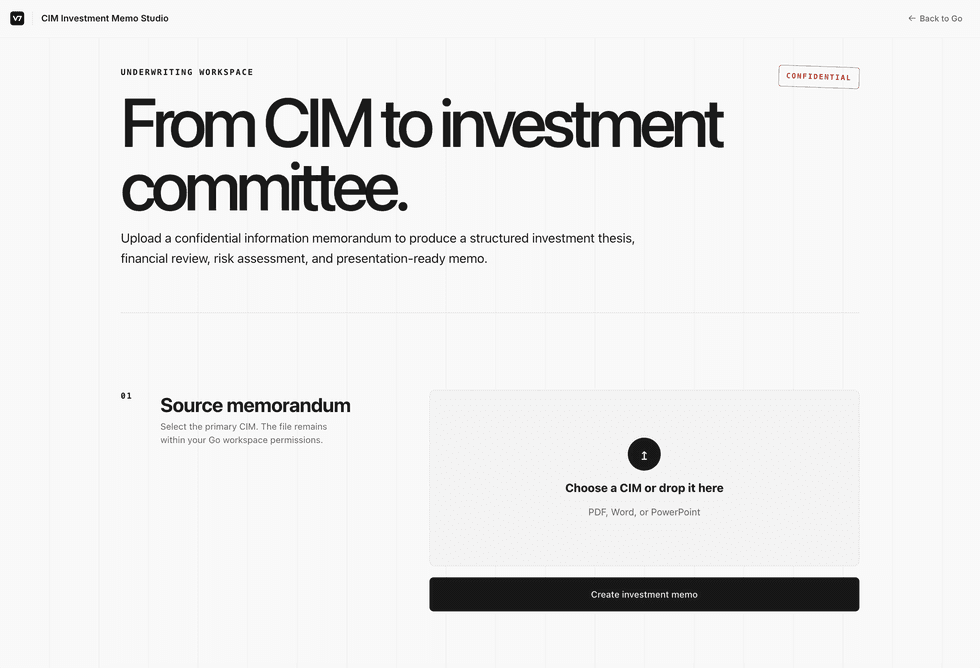
An app is how you hand a workflow to someone without handing over the workflow. They get a page with the inputs it needs and a button to run it. The prompts, the tools and the steps stay behind it, out of view and out of reach.
You can create V7 Go Apps in chats. Describe the app and name the workflow it should run. V7 Go builds it, binds to that workflow, and publishes it when you approve.
What stays behind it
The instructions: Prompts and step instructions are not shown in the app and cannot be read from it.
The tools and the model: No tool list, no model picker. The app runs the configuration you set.
The ability to change any of it: An app is a way to run a workflow, not a way into it. Editing stays with the people who have workflow permissions.
The person running it sees a titled page, the inputs the workflow needs, and the result when it finishes. The run takes the route you configured, every time, and an uploaded file stays inside the workspace permissions it arrived under.
Building an app
In a chat, describe the app and name the workflow it should run.
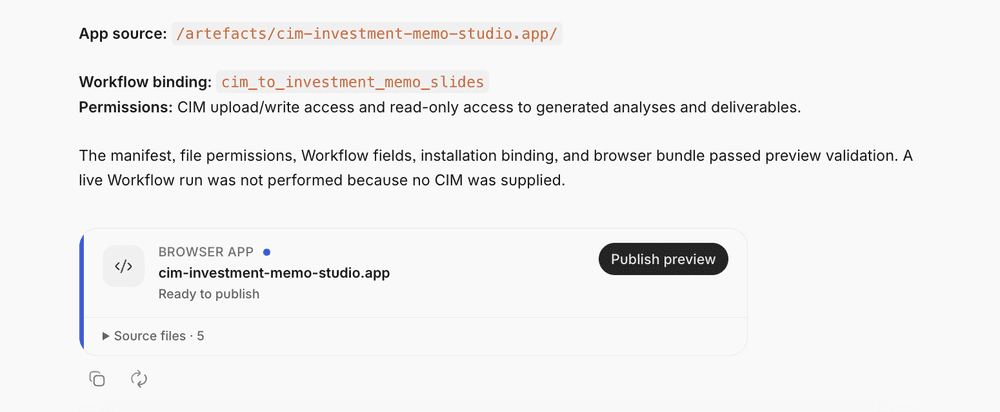
Review what V7 Go reports back: the app source, the workflow it is bound to, and the permissions it needs.
Use Publish preview. The app then appears under Apps in the left navigation, where anyone with access can find and run it.
Availability
Apps are behind a feature flag and switched on per workspace. Ask your V7 contact to enable it.

Read more
Apps: Run a Workflow Without Opening It
An app is how you hand a workflow to someone without handing over the workflow. They get a page with the inputs it needs and a button to run it. The prompts, the tools and the steps stay behind it, out of view and out of reach.
You can create V7 Go Apps in chats. Describe the app and name the workflow it should run. V7 Go builds it, binds to that workflow, and publishes it when you approve.
What stays behind it
The instructions: Prompts and step instructions are not shown in the app and cannot be read from it.
The tools and the model: No tool list, no model picker. The app runs the configuration you set.
The ability to change any of it: An app is a way to run a workflow, not a way into it. Editing stays with the people who have workflow permissions.
The person running it sees a titled page, the inputs the workflow needs, and the result when it finishes. The run takes the route you configured, every time, and an uploaded file stays inside the workspace permissions it arrived under.
Building an app
In a chat, describe the app and name the workflow it should run.
Review what V7 Go reports back: the app source, the workflow it is bound to, and the permissions it needs.
Use Publish preview. The app then appears under Apps in the left navigation, where anyone with access can find and run it.
Availability
Apps are behind a feature flag and switched on per workspace. Ask your V7 contact to enable it.
Read more
Go Agent V2: Pick the Model, Check the Quote, Replay the Run
Chats run on Go Agent V2. You choose the model and how hard it thinks, an answer shows the sentence it came from, and a run that hits a bad step can be replayed instead of started again.
V2 is the second version of what runs a chat, and the difference shows up in long work. It holds a conversation together across many turns and tool calls, keeps the files you gave it readable the whole way through, and records enough of what it did that the run can be read back afterwards.
Choosing the model
Curated models, and how hard they think: Chat carries a model picker and a reasoning setting, so a quick lookup and a long piece of analysis do not have to run the same way. A run uses the model you chose rather than one it inherited.
The settings name the model: The settings tooltip names the concrete model instead of a generic label, so you can tell what a chat is actually running.
A wider list to choose from: GPT-6 Astra, Gemini 3.7 Flash and Gemini 3.8 Flash are all selectable, and Gemini 2.5 Pro has been retired.
Answers carry their source
Quoted, not tagged: A source is attributed by the text it quotes rather than by a citation marker, so checking where an answer came from is a matter of reading it.
Claims in a case are grounded: A response in a case carries references to the documents behind each claim, rather than asking you to take the summary on trust.
Long runs hold together
Your files stay readable: Documents in a conversation remain available as a long chat is compacted, so something attached early is still there late.
The transcript is complete: Every turn is kept, and every tool call is stored alongside the result it returned, so an audit or a playback shows the whole run.
A malformed step is replayable: A run that hits a malformed tool call can be replayed and debugged rather than failing permanently.
A slow tool ends: A tool result that takes too long returns an error instead of leaving the run hanging.
Late work cannot overwrite a finished answer: A background job that arrives after the fact no longer replaces an answer you already have.
It can see your Workflows
Live results: Workflow results can be read while the workflow is still running, rather than only once it finishes.
Rows and fields are navigable: A workflow row or field opens from the chat, so checking a value does not mean leaving the conversation.
Result files arrive in the chat: Files a run produces are attached where you asked for them, and stay attached when a workflow finishes early.
Bounded, and attributable
Runtime limits: Soft and hard limits stop a run from going on indefinitely.
Tool calls count as activity: An MCP tool invocation is recorded as user activity, with the origin and the sign-in route behind it, so a review can attribute it to the person behind it.
Availability
Go Agent V2 is what chats run on. There is nothing to switch on.
Read more
Go Agent V2: Pick the Model, Check the Quote, Replay the Run
Chats run on Go Agent V2. You choose the model and how hard it thinks, an answer shows the sentence it came from, and a run that hits a bad step can be replayed instead of started again.
V2 is the second version of what runs a chat, and the difference shows up in long work. It holds a conversation together across many turns and tool calls, keeps the files you gave it readable the whole way through, and records enough of what it did that the run can be read back afterwards.
Choosing the model
Curated models, and how hard they think: Chat carries a model picker and a reasoning setting, so a quick lookup and a long piece of analysis do not have to run the same way. A run uses the model you chose rather than one it inherited.
The settings name the model: The settings tooltip names the concrete model instead of a generic label, so you can tell what a chat is actually running.
A wider list to choose from: GPT-6 Astra, Gemini 3.7 Flash and Gemini 3.8 Flash are all selectable, and Gemini 2.5 Pro has been retired.
Answers carry their source
Quoted, not tagged: A source is attributed by the text it quotes rather than by a citation marker, so checking where an answer came from is a matter of reading it.
Claims in a case are grounded: A response in a case carries references to the documents behind each claim, rather than asking you to take the summary on trust.
Long runs hold together
Your files stay readable: Documents in a conversation remain available as a long chat is compacted, so something attached early is still there late.
The transcript is complete: Every turn is kept, and every tool call is stored alongside the result it returned, so an audit or a playback shows the whole run.
A malformed step is replayable: A run that hits a malformed tool call can be replayed and debugged rather than failing permanently.
A slow tool ends: A tool result that takes too long returns an error instead of leaving the run hanging.
Late work cannot overwrite a finished answer: A background job that arrives after the fact no longer replaces an answer you already have.
It can see your Workflows
Live results: Workflow results can be read while the workflow is still running, rather than only once it finishes.
Rows and fields are navigable: A workflow row or field opens from the chat, so checking a value does not mean leaving the conversation.
Result files arrive in the chat: Files a run produces are attached where you asked for them, and stay attached when a workflow finishes early.
Bounded, and attributable
Runtime limits: Soft and hard limits stop a run from going on indefinitely.
Tool calls count as activity: An MCP tool invocation is recorded as user activity, with the origin and the sign-in route behind it, so a review can attribute it to the person behind it.
Availability
Go Agent V2 is what chats run on. There is nothing to switch on.
Read more
MCP Connectors: A Growing Catalogue, Guided Setup, and Verified Connections
V7 Go reaches more than forty systems through MCP, and connectors are added regularly. Connecting one is a guided flow now: browse the catalogue, fill in what the connector asks for, and see the connection verified before you rely on it.
The catalogue exists so that connecting a familiar tool is a short job rather than a project. Each connector in it has already been set up against V7 Go, so what is left to you is a short form rather than a server to wire up. Anything not in the catalogue can still be added as a custom connector.
Setting one up
Browse, do not hunt: The catalogue lists what is available with a page per connector, so finding the right one does not start with knowing its name.
The connection is verified, not assumed: A connect attempt is checked and the result reported back, and a failure is stored with its error rather than leaving you to guess why nothing works.
A credential form that checks itself: Each connector asks for what it needs in a form that validates the input as you fill it, rather than accepting anything and failing later.
Fewer steps that do not apply: OAuth client setup is optional rather than required, failed tool loading can be retried, and a streamed response is matched to the request that asked for it.
Connectors come first in tool search: Tool search surfaces MCP connectors ahead of other results, so what you connected is what you find.
What is in the catalogue
Deals and CRM: Affinity, Apollo.io, Attio, Clay, HubSpot and Pipedrive.
Market and portfolio data: Capital IQ, PitchBook and Yardi.
Documents, storage and knowledge: Airtable, Box, Coda, Dropbox, Egnyte, Glean, Google Docs, Google Drive, Google Sheets, Google Slides and Notion.
Email, chat and calls: Fireflies.ai, Gmail, Gong, Google Calendar, Google Chat, Google Contacts, Granola, Intercom, Intercom (EU), Slack and Work IQ.
Projects and engineering: Asana, Atlassian Rovo, ClickUp, Figma, GitHub, LaunchDarkly, Linear and Monday.com.
Contracts and payments: PandaDoc, PandaDoc (EU) and Stripe.
The list keeps growing. New connectors go in as they are built, so it is worth a look even if the tool you wanted was missing last time.
Anything else, as a custom connector
A niche or in-house tool does not have to wait for the catalogue. The custom MCP connector action sits in the top bar: point it at the server and it works alongside the rest. The catalogue is the short path for the tools most teams already use, not the boundary of what V7 Go can reach.
Once it is connected
Tools are scoped to their connector: Tools are discovered per connector and carry a stable identity, so a tool name means the same thing from one run to the next.
Connector names survive the handoff: A connector name, and a mention that cannot be resolved, are both preserved rather than quietly dropped.
Tool use is recorded as activity: An MCP tool invocation is logged as user activity, with the origin and the sign-in route behind it, so a review can answer who used what.
Versions are pinned and visible: The component version behind a workflow is recorded and shown, and a skill pinned to an out-of-date version is flagged before it breaks.
Availability
The catalogue is under Integrations, in MCP connectors, along with the custom connector action.
Read more
MCP Connectors: A Growing Catalogue, Guided Setup, and Verified Connections
V7 Go reaches more than forty systems through MCP, and connectors are added regularly. Connecting one is a guided flow now: browse the catalogue, fill in what the connector asks for, and see the connection verified before you rely on it.
The catalogue exists so that connecting a familiar tool is a short job rather than a project. Each connector in it has already been set up against V7 Go, so what is left to you is a short form rather than a server to wire up. Anything not in the catalogue can still be added as a custom connector.
Setting one up
Browse, do not hunt: The catalogue lists what is available with a page per connector, so finding the right one does not start with knowing its name.
The connection is verified, not assumed: A connect attempt is checked and the result reported back, and a failure is stored with its error rather than leaving you to guess why nothing works.
A credential form that checks itself: Each connector asks for what it needs in a form that validates the input as you fill it, rather than accepting anything and failing later.
Fewer steps that do not apply: OAuth client setup is optional rather than required, failed tool loading can be retried, and a streamed response is matched to the request that asked for it.
Connectors come first in tool search: Tool search surfaces MCP connectors ahead of other results, so what you connected is what you find.
What is in the catalogue
Deals and CRM: Affinity, Apollo.io, Attio, Clay, HubSpot and Pipedrive.
Market and portfolio data: Capital IQ, PitchBook and Yardi.
Documents, storage and knowledge: Airtable, Box, Coda, Dropbox, Egnyte, Glean, Google Docs, Google Drive, Google Sheets, Google Slides and Notion.
Email, chat and calls: Fireflies.ai, Gmail, Gong, Google Calendar, Google Chat, Google Contacts, Granola, Intercom, Intercom (EU), Slack and Work IQ.
Projects and engineering: Asana, Atlassian Rovo, ClickUp, Figma, GitHub, LaunchDarkly, Linear and Monday.com.
Contracts and payments: PandaDoc, PandaDoc (EU) and Stripe.
The list keeps growing. New connectors go in as they are built, so it is worth a look even if the tool you wanted was missing last time.
Anything else, as a custom connector
A niche or in-house tool does not have to wait for the catalogue. The custom MCP connector action sits in the top bar: point it at the server and it works alongside the rest. The catalogue is the short path for the tools most teams already use, not the boundary of what V7 Go can reach.
Once it is connected
Tools are scoped to their connector: Tools are discovered per connector and carry a stable identity, so a tool name means the same thing from one run to the next.
Connector names survive the handoff: A connector name, and a mention that cannot be resolved, are both preserved rather than quietly dropped.
Tool use is recorded as activity: An MCP tool invocation is logged as user activity, with the origin and the sign-in route behind it, so a review can answer who used what.
Versions are pinned and visible: The component version behind a workflow is recorded and shown, and a skill pinned to an out-of-date version is flagged before it breaks.
Availability
The catalogue is under Integrations, in MCP connectors, along with the custom connector action.
Read more
Custom Organization Branding, Audit-Ready Activity Logs, and Raw Deal Exports
An organization can carry its own logo and name. Activity logs record where each action came from and how the person signed in, Co-Investment and DealCloud data exports raw, and a run that hit a malformed step can be replayed instead of written off.
Organization
Your logo and name: An admin can set a custom organization logo and name, so shared spaces and reports carry your branding rather than a default.
Audit and activity
Activity logs record origin and sign-in: Each action carries where it came from and how the user authenticated, including the owner behind an API key, so a review can answer who did what and through which route.
Tool use counts as activity: An MCP tool invocation is recorded as user activity rather than going unattributed.
Exports and files
Raw Co-Investment, Co-Investor and DealCloud exports: The underlying data comes out in its original shape, so it can be analysed or reported on without being unpicked first. The Deal export tolerates schema drift rather than failing on it.
Copy a generated file in one click: A file a run produces can be copied straight from where it appears, without opening or downloading it first.
PowerPoint exports open: A generated deck is valid on download rather than needing repair.
Workflow result files work with read-only tools: A completed output can be inspected directly, with no extra access step.
Workflows
One flow for questions: When a workflow needs your input, questions arrive in a single consistent flow instead of jumping between steps, and sequential extracts stay inline.
Replay a malformed run: A run with a malformed step can be replayed and debugged rather than failing permanently, so a broken run is recoverable.
Duplicate JSON keys are rejected: An output with duplicate keys is caught at validation rather than flowing downstream.
Python results appear after a run: A completed Python run shows its output instead of needing a rerun to see work that already happened.
Integrations
See which component version a workflow uses: The Pipedream component version behind a workflow is recorded and shown, so a change can be traced rather than guessed at.
Stale components are flagged: A skill pinned to an out-of-date component is marked, so an admin catches it before it breaks.
Steadier action setup: Configuration keeps its pinned version and keeps fetching remote options for fields that do not support querying, so a form stops resetting under you.
Integration templates show when they arrived: A template carries its date added, so newer options are easy to spot while browsing.
Reporting
Active users as a chart: The Users report draws active users, so adoption reads as a trend rather than a number.
See who is on a workflow: Hovering a teammate indicator shows who is working on a workflow right now.
Run reports arrive sooner: A report appears when the main run finishes, rather than waiting on background work that is still settling.
The Models report hides what nobody used: Models with no real usage are left out, so the view is about what your team actually runs.
Billing counts Workflows: Usage counts say Workflow rather than Project, matching the rest of the product.
Clearer failures
AskExcel explains itself: A failed AskExcel command says what went wrong, so the request can be adjusted rather than retried blind.
Context assembly stops crying wolf: A context-assembly problem is no longer reported and retried as an internal tool error.
Interface
Readable avatar initials: Initials hold their contrast against the brighter palette backgrounds.
A simpler Home composer: Category shortcuts under the composer are gone, so the starting screen is the composer.
Calmer field card editing: Opening a field card to edit reveals it smoothly, with restyled controls.
Read more
Custom Organization Branding, Audit-Ready Activity Logs, and Raw Deal Exports
An organization can carry its own logo and name. Activity logs record where each action came from and how the person signed in, Co-Investment and DealCloud data exports raw, and a run that hit a malformed step can be replayed instead of written off.
Organization
Your logo and name: An admin can set a custom organization logo and name, so shared spaces and reports carry your branding rather than a default.
Audit and activity
Activity logs record origin and sign-in: Each action carries where it came from and how the user authenticated, including the owner behind an API key, so a review can answer who did what and through which route.
Tool use counts as activity: An MCP tool invocation is recorded as user activity rather than going unattributed.
Exports and files
Raw Co-Investment, Co-Investor and DealCloud exports: The underlying data comes out in its original shape, so it can be analysed or reported on without being unpicked first. The Deal export tolerates schema drift rather than failing on it.
Copy a generated file in one click: A file a run produces can be copied straight from where it appears, without opening or downloading it first.
PowerPoint exports open: A generated deck is valid on download rather than needing repair.
Workflow result files work with read-only tools: A completed output can be inspected directly, with no extra access step.
Workflows
One flow for questions: When a workflow needs your input, questions arrive in a single consistent flow instead of jumping between steps, and sequential extracts stay inline.
Replay a malformed run: A run with a malformed step can be replayed and debugged rather than failing permanently, so a broken run is recoverable.
Duplicate JSON keys are rejected: An output with duplicate keys is caught at validation rather than flowing downstream.
Python results appear after a run: A completed Python run shows its output instead of needing a rerun to see work that already happened.
Integrations
See which component version a workflow uses: The Pipedream component version behind a workflow is recorded and shown, so a change can be traced rather than guessed at.
Stale components are flagged: A skill pinned to an out-of-date component is marked, so an admin catches it before it breaks.
Steadier action setup: Configuration keeps its pinned version and keeps fetching remote options for fields that do not support querying, so a form stops resetting under you.
Integration templates show when they arrived: A template carries its date added, so newer options are easy to spot while browsing.
Reporting
Active users as a chart: The Users report draws active users, so adoption reads as a trend rather than a number.
See who is on a workflow: Hovering a teammate indicator shows who is working on a workflow right now.
Run reports arrive sooner: A report appears when the main run finishes, rather than waiting on background work that is still settling.
The Models report hides what nobody used: Models with no real usage are left out, so the view is about what your team actually runs.
Billing counts Workflows: Usage counts say Workflow rather than Project, matching the rest of the product.
Clearer failures
AskExcel explains itself: A failed AskExcel command says what went wrong, so the request can be adjusted rather than retried blind.
Context assembly stops crying wolf: A context-assembly problem is no longer reported and retried as an internal tool error.
Interface
Readable avatar initials: Initials hold their contrast against the brighter palette backgrounds.
A simpler Home composer: Category shortcuts under the composer are gone, so the starting screen is the composer.
Calmer field card editing: Opening a field card to edit reveals it smoothly, with restyled controls.
Read more
Guided MCP Connector Setup, Two Gemini Flash Models, and Steerable Queued Messages
Connecting an MCP tool is now a guided flow with a browsable catalogue, reusable credentials and a check that the connection actually works. Two new Gemini Flash models are available, and a queued chat message can be steered before it sends.
Connectors
Guided MCP setup: Connecting a tool walks through its own setup: browse the connector catalogue, open a connector page for what it needs, fill a credential form, and see the connection verified before you rely on it.
Credentials are reused: A credential entered once is offered again for the next connector that needs it, rather than being retyped.
Connectors come first in tool search: Tool search surfaces MCP connectors ahead of other results, so the thing you are looking for is at the top.
Fewer dead ends: OAuth client setup is optional where the connector does not need it, failed tool loading can be retried, and a streamed response is matched to the request that asked for it.
Gong call filters are not blocked by setup: Call filters stay available when workspace selection is optional.
Models
Gemini 3.7 Flash and Gemini 3.8 Flash: Both are available for workflows and agent configurations, and are the lighter choice when a run does not need a frontier model.
Chat
Steer a queued message: A message waiting to send can be adjusted or redirected before it goes, so a change of mind does not mean cancelling the turn.
Co-agent chats report progress: A longer interaction shows what is happening while it happens, rather than going quiet until it finishes.
Reporting
One filter control, now with Models and Hubs: Report filters are unified into a single interface and cover models and hubs, instead of a separate control per dimension.
Hub reports say when collection began: A hub report shows the date its data starts, so a trend is read against the right baseline.
Complete model names in CSV exports: An exported CSV carries the full model name rather than leaving the column blank.
Reliability
Python says when capacity is full: A Python run that cannot get capacity explains itself instead of failing silently.
Steadier visual citations: Visual reading caps its rasters and normalises citation boxes, so references come back in a consistent form.
SharePoint requests reach the right tenant: File picking and connected SharePoint workflows route correctly.
Current timezone rules: Timezone data is up to date, so dates and schedules survive the latest daylight saving changes.
Read more
Guided MCP Connector Setup, Two Gemini Flash Models, and Steerable Queued Messages
Connecting an MCP tool is now a guided flow with a browsable catalogue, reusable credentials and a check that the connection actually works. Two new Gemini Flash models are available, and a queued chat message can be steered before it sends.
Connectors
Guided MCP setup: Connecting a tool walks through its own setup: browse the connector catalogue, open a connector page for what it needs, fill a credential form, and see the connection verified before you rely on it.
Credentials are reused: A credential entered once is offered again for the next connector that needs it, rather than being retyped.
Connectors come first in tool search: Tool search surfaces MCP connectors ahead of other results, so the thing you are looking for is at the top.
Fewer dead ends: OAuth client setup is optional where the connector does not need it, failed tool loading can be retried, and a streamed response is matched to the request that asked for it.
Gong call filters are not blocked by setup: Call filters stay available when workspace selection is optional.
Models
Gemini 3.7 Flash and Gemini 3.8 Flash: Both are available for workflows and agent configurations, and are the lighter choice when a run does not need a frontier model.
Chat
Steer a queued message: A message waiting to send can be adjusted or redirected before it goes, so a change of mind does not mean cancelling the turn.
Co-agent chats report progress: A longer interaction shows what is happening while it happens, rather than going quiet until it finishes.
Reporting
One filter control, now with Models and Hubs: Report filters are unified into a single interface and cover models and hubs, instead of a separate control per dimension.
Hub reports say when collection began: A hub report shows the date its data starts, so a trend is read against the right baseline.
Complete model names in CSV exports: An exported CSV carries the full model name rather than leaving the column blank.
Reliability
Python says when capacity is full: A Python run that cannot get capacity explains itself instead of failing silently.
Steadier visual citations: Visual reading caps its rasters and normalises citation boxes, so references come back in a consistent form.
SharePoint requests reach the right tenant: File picking and connected SharePoint workflows route correctly.
Current timezone rules: Timezone data is up to date, so dates and schedules survive the latest daylight saving changes.
Read more
GPT-6 Astra, Quoted Sources, and Complete Run Transcripts
GPT-6 Astra is available in conversations. A source reference now shows the exact quoted text behind an answer, and a run transcript keeps every user turn rather than a summary of them.
Models
GPT-6 Astra: Available for use in conversations.
Answers and sources
Sources show the quote: A source reference is attributed by the quoted text behind the answer rather than by a citation tag, so checking where a response came from is a matter of reading it.
Complete run transcripts: Every user turn in a run is kept, so an audit or a playback shows the whole conversation instead of part of it.
One search for agent skills: Agent Skill discovery runs through a single search across the platform, rather than a separate lookup per surface.
Clearer failures
Temporary and permanent read failures read differently: When content cannot be read, the response says whether it is worth retrying.
Still indexing is not the same as not searchable: Search and grep distinguish content that is still being prepared from content that cannot be searched, so an empty result explains itself.
Speed and reliability
Background results arrive together, sooner: Results are delivered as soon as the final background task finishes, which shows most when several actions run in parallel.
Steadier nested runs: Nested steps no longer reach for tool patterns that are unsupported at that depth, so longer runs complete more predictably.
Reporting
Workflows reports drop backing projects: Projects that back a workflow are excluded from its report, so the figures describe the workflow.
One last-activity time: A user last activity time reads the same wherever it appears.
Report pages stop jumping: Space is reserved for the scrollbar, so content does not shift as a long report loads.
Interface
Tool results render in chat: A message that carries results from a connected tool displays correctly rather than breaking the thread.
Read more
GPT-6 Astra, Quoted Sources, and Complete Run Transcripts
GPT-6 Astra is available in conversations. A source reference now shows the exact quoted text behind an answer, and a run transcript keeps every user turn rather than a summary of them.
Models
GPT-6 Astra: Available for use in conversations.
Answers and sources
Sources show the quote: A source reference is attributed by the quoted text behind the answer rather than by a citation tag, so checking where a response came from is a matter of reading it.
Complete run transcripts: Every user turn in a run is kept, so an audit or a playback shows the whole conversation instead of part of it.
One search for agent skills: Agent Skill discovery runs through a single search across the platform, rather than a separate lookup per surface.
Clearer failures
Temporary and permanent read failures read differently: When content cannot be read, the response says whether it is worth retrying.
Still indexing is not the same as not searchable: Search and grep distinguish content that is still being prepared from content that cannot be searched, so an empty result explains itself.
Speed and reliability
Background results arrive together, sooner: Results are delivered as soon as the final background task finishes, which shows most when several actions run in parallel.
Steadier nested runs: Nested steps no longer reach for tool patterns that are unsupported at that depth, so longer runs complete more predictably.
Reporting
Workflows reports drop backing projects: Projects that back a workflow are excluded from its report, so the figures describe the workflow.
One last-activity time: A user last activity time reads the same wherever it appears.
Report pages stop jumping: Space is reserved for the scrollbar, so content does not shift as a long report loads.
Interface
Tool results render in chat: A message that carries results from a connected tool displays correctly rather than breaking the thread.
Read more
Slideshow Tools for Everyone, Agents in the Tool Picker, and Decide For Me
Slideshow Tools v2 is on for everyone. The property tool picker names agent tools as Agents, and Decide for me answers the question in front of it instead of stepping past it.
Heads up
Gemini 2.5 Pro has been retired: It no longer appears as a selectable model, so nothing can be pointed at a model on its way out.
Tools
Slideshow Tools v2, for everyone: The updated slideshow tools are on by default, with nothing to enable first.
Agents are named in the property tool picker: Agent tools are labelled Agents, so they are easy to tell apart from the other tools a property can use.
Skill mentions read as references: A skill mentioned in a message renders as a clear, clickable reference rather than raw text, so you can see which skill was invoked and open it.
Pass part of an object into a skill: A skill argument can reference specific fields of an object, so one skill covers more cases without a variant for each shape.
Refreshed Salesforce skills: The Salesforce Pipedream skills have been regenerated against current actions.
Chat and questions
Decide for me decides: It answers the question in front of it rather than moving past it, so it completes the choice instead of skipping the work.
Redesigned suggested options: Option cards are cleaner to scan, which makes a run of questions quicker to move through.
Chats resume after a skill finishes: A successful skill run hands back to the conversation on its own, with nothing to restart.
Notifications survive long work: Progress updates and handoffs are delivered durably, so a long run still reports back.
Workflows and reporting
A dedicated card for a workflow run: A run opens in its own card, so progress and the next step sit in one place.
Workspace usage reflects real limits: System limits are included, so remaining capacity reads against the boundary that actually applies.
Internal tools are marked in usage reports: Internal tooling is named and flagged in Mission Control usage, so a line item does not have to be guessed at.
Provider details read consistently: Provider information is presented the same way across reports.
Snapshots keep short-lived users: A report snapshot carries temporary user details, so it matches what was true at the time.
Accessibility
Project tables and inline fields announce properly: The project table grid structure and inline text fields carry the names and roles a screen reader needs.
Read more
Slideshow Tools for Everyone, Agents in the Tool Picker, and Decide For Me
Slideshow Tools v2 is on for everyone. The property tool picker names agent tools as Agents, and Decide for me answers the question in front of it instead of stepping past it.
Heads up
Gemini 2.5 Pro has been retired: It no longer appears as a selectable model, so nothing can be pointed at a model on its way out.
Tools
Slideshow Tools v2, for everyone: The updated slideshow tools are on by default, with nothing to enable first.
Agents are named in the property tool picker: Agent tools are labelled Agents, so they are easy to tell apart from the other tools a property can use.
Skill mentions read as references: A skill mentioned in a message renders as a clear, clickable reference rather than raw text, so you can see which skill was invoked and open it.
Pass part of an object into a skill: A skill argument can reference specific fields of an object, so one skill covers more cases without a variant for each shape.
Refreshed Salesforce skills: The Salesforce Pipedream skills have been regenerated against current actions.
Chat and questions
Decide for me decides: It answers the question in front of it rather than moving past it, so it completes the choice instead of skipping the work.
Redesigned suggested options: Option cards are cleaner to scan, which makes a run of questions quicker to move through.
Chats resume after a skill finishes: A successful skill run hands back to the conversation on its own, with nothing to restart.
Notifications survive long work: Progress updates and handoffs are delivered durably, so a long run still reports back.
Workflows and reporting
A dedicated card for a workflow run: A run opens in its own card, so progress and the next step sit in one place.
Workspace usage reflects real limits: System limits are included, so remaining capacity reads against the boundary that actually applies.
Internal tools are marked in usage reports: Internal tooling is named and flagged in Mission Control usage, so a line item does not have to be guessed at.
Provider details read consistently: Provider information is presented the same way across reports.
Snapshots keep short-lived users: A report snapshot carries temporary user details, so it matches what was true at the time.
Accessibility
Project tables and inline fields announce properly: The project table grid structure and inline text fields carry the names and roles a screen reader needs.
Read more
Load More
Build once.
Deploy across teams.
Improve over time.

Constance Freedman
Founder and Managing Partner
Moderne Ventures
Build once.
Deploy across teams.
Improve over time.
Constance Freedman
Founder and Managing Partner
Moderne Ventures
Build once.
Deploy across teams.
Improve over time.